
Snacka: From Language Learning to Language Usage
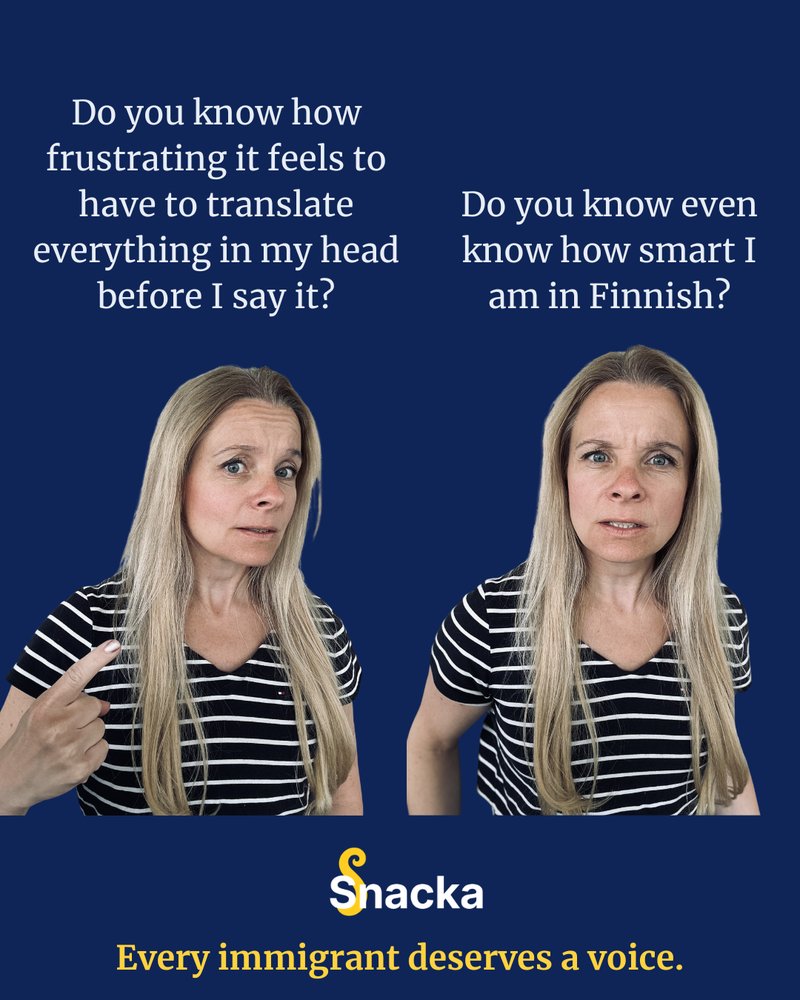
How Snacka is solving the speaking problem
Snacka was built around a simple idea: speaking confidence develops in real life, not on a screen. The platform allows learners to practice realistic conversations before they happen, helping them feel more prepared for everyday interactions such as healthcare visits, public services, workplaces, and social situations. The purpose is not to keep users inside the application, but to help them step outside of it with greater confidence.
We provide a large library of predefined scenarios, and users can also create their own in real time. These scenarios allow learners to practice in situations before they occur in real life, so that when they do, they are familiar, manageable, and less stressful.
Our focus is not on teaching the language itself, but on enabling users to use the language effectively when it matters. We design for outcome, not just learning progression. The goal is to reduce uncertainty, increase confidence, and make integration into everyday life smoother through consistent real-world practice.
Why this solution matters in real life
Most language learning tools focus on controlled or simplified conversation practice. However, real-life communication is often unpredictable, context-heavy, and high-pressure.
In real life, learners face situations such as:
- interacting in healthcare settings where English may not be used
- describing the electrical fault at home to an electrician
- communicating with authorities or public services
- resolving misunderstandings in everyday interactions
These are not “small talk” scenarios — they are high-stakes communication moments. Just like Gloria from Modern Family says how smart she sounds in Spanish is what we want to make you feel in your second language.
Snacka is built around exactly these situations. The team behind Snacka consists of resilient immigrants who have lived in different countries, learned new languages, and experienced the stress and vulnerability of speaking in real-life situations. We know what it feels like to hesitate before ordering food, panic during important conversations, or avoid situations entirely out of fear of saying something wrong.
Snacka was created from those experiences and from the belief that language learning should prepare people for the moments that actually matter in everyday life.
Integration does not end at the intermediate level
In Finland and similar contexts, many language learning applications, as well as broader public narratives surrounding the YKI test (National Certificate of Language Proficiency), often position CEFR B1, or “limited working proficiency,” as sufficient for functioning in Finnish society. While reaching this level is an important milestone and one of the criteria required for citizenship, it does not necessarily translate into confidence or fluency in real-life communication. For many learners, language development slows down significantly after reaching the intermediate level. Learners may technically “pass” the language benchmark yet still struggle with spontaneous conversation, fast-paced spoken Finnish, workplace communication, or high-pressure everyday interactions. Integration, however, does not end at B1 proficiency. Participating fully in society often requires continued development of practical communication skills beyond standardised testing environments.
At the same time, many learners struggle to find tools that support advanced, real-world speaking practice once they reach intermediate proficiency. Existing platforms frequently focus either on beginner-level language acquisition or exam preparation, leaving a gap between passing a language requirement and confidently using the language in everyday life. Snacka aims to address this gap by supporting learners who already possess foundational language knowledge but want to improve fluency, confidence under pressure, and situational readiness in real-world communications.