
The Missing Layer in Language Learning: Where Snacka Fits in the Market?
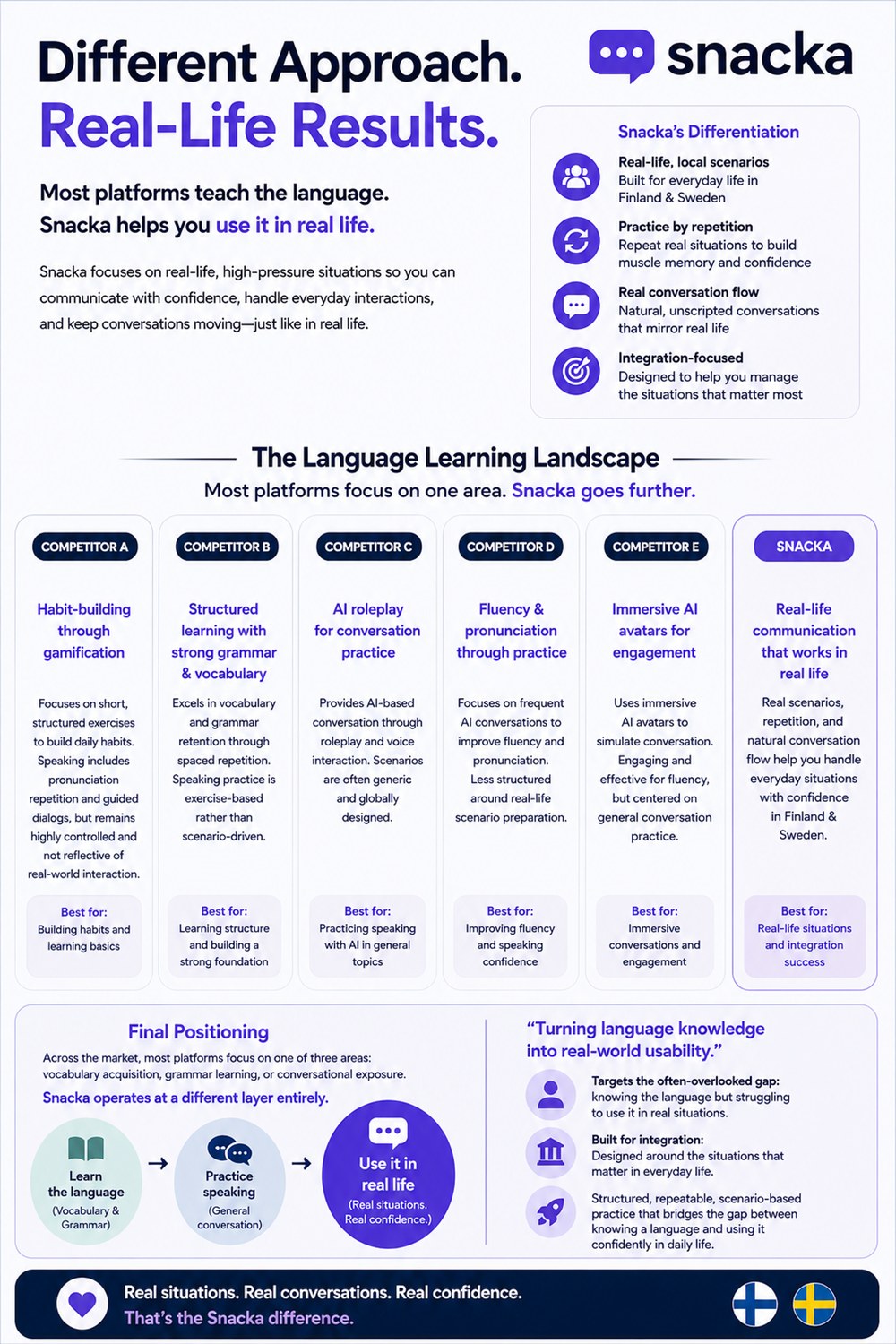
Snacka’s positioning with respect to competitors
Existing platforms approach speaking in different ways, but most still primarily focus on language learning, with an emphasis on vocabulary, grammar, and correct sentence structure. Feedback is often centered on mistakes and linguistic accuracy rather than on whether the learner was able to successfully navigate the task given or an actual real-life situation.
Snacka takes a different approach by focusing on language usage in realistic, high-pressure contexts. Instead of emphasizing perfect grammar, the platform prioritizes communication, confidence, and situational readiness, helping learners practice how to respond, adapt, and keep conversations moving in everyday life, much like how a real-life conversation would go.
Competitor A focuses on habit-building through gamification and short structured exercises. Its speaking features include pronunciation repetition and guided dialogues, but these remain highly controlled and not reflective of real-world interaction. Snacka instead focuses on extended, realistic conversational scenarios that mirror actual life situations.
Competitor B is strong in structured Finnish learning, especially vocabulary and grammar retention through spaced repetition. However, its speaking practice is primarily exercise-based rather than scenario-driven. Snacka focuses instead on real-life contextual speaking, such as public services, shopping, and daily interactions.
Competitor C provides AI-based conversational practice through roleplay and voice interaction. While this increases speaking exposure, the scenarios are often generic and globally designed. Snacka narrows this down to locally relevant, integration-focused situations specific to environments like Finland and Sweden.
Competitor D focuses heavily on fluency and pronunciation through frequent AI conversation. However, it is less structured around real-life scenario preparation. Snacka instead emphasizes repetition of practical situations where users build confidence for real-world interactions.
Competitor E uses immersive AI avatars to simulate conversation. While this improves engagement and fluency, it remains centered on general conversation practice rather than situational readiness. Snacka prioritizes contextual realism and repeated practice of real-life communication scenarios, while also providing feedback after each conversation on performance, communication effectiveness, and areas for improvement.
Note: our vocabulary learning and grammar practice is embedded — you can always ask the app if you don’t understand some grammar or lack vocabulary.
What makes us different?
Across the market, most language platforms focus on one of three areas: vocabulary acquisition, grammar learning, or conversational exposure. Snacka operates at a different layer entirely.
Snacka targets a more specific and often overlooked gap: the ability to confidently use language in real-life situations under real constraints.
This distinction is especially important in integration contexts, where learners may already understand the language but still struggle to speak it in practice.
Snacka addresses this gap by providing structured, repeatable, scenario-based speaking practice that bridges the space between knowing a language and actually using it in daily life.